

May Outturn 2025 Feature Article
Wood is paramount to the pleasures of drinking whisky as it contributes the greatest aromas, flavours, mouthfeel, and all the colour*.
All major whisky-producing countries have varying statutes on wood, capacity and maturation. These are due to historical production practices, cultural traditions, forestry resources, and local environmental conditions affecting maturation. In the U.S., corn whisky does not have to touch wood; straight classes, such as bourbon, must spend at least two years in charred new oak containers since 1936. Canada, two years in ‘small wood’ (under 700 litres) since 1949. Ireland, a maximum of three years in a wooden container from 1969, was five years from 1926. Scotland has required at least three years of wood since 1915 and specified ‘oak casks of a capacity not exceeding 700 litres’ in 1990. Japan has no wood requirements.
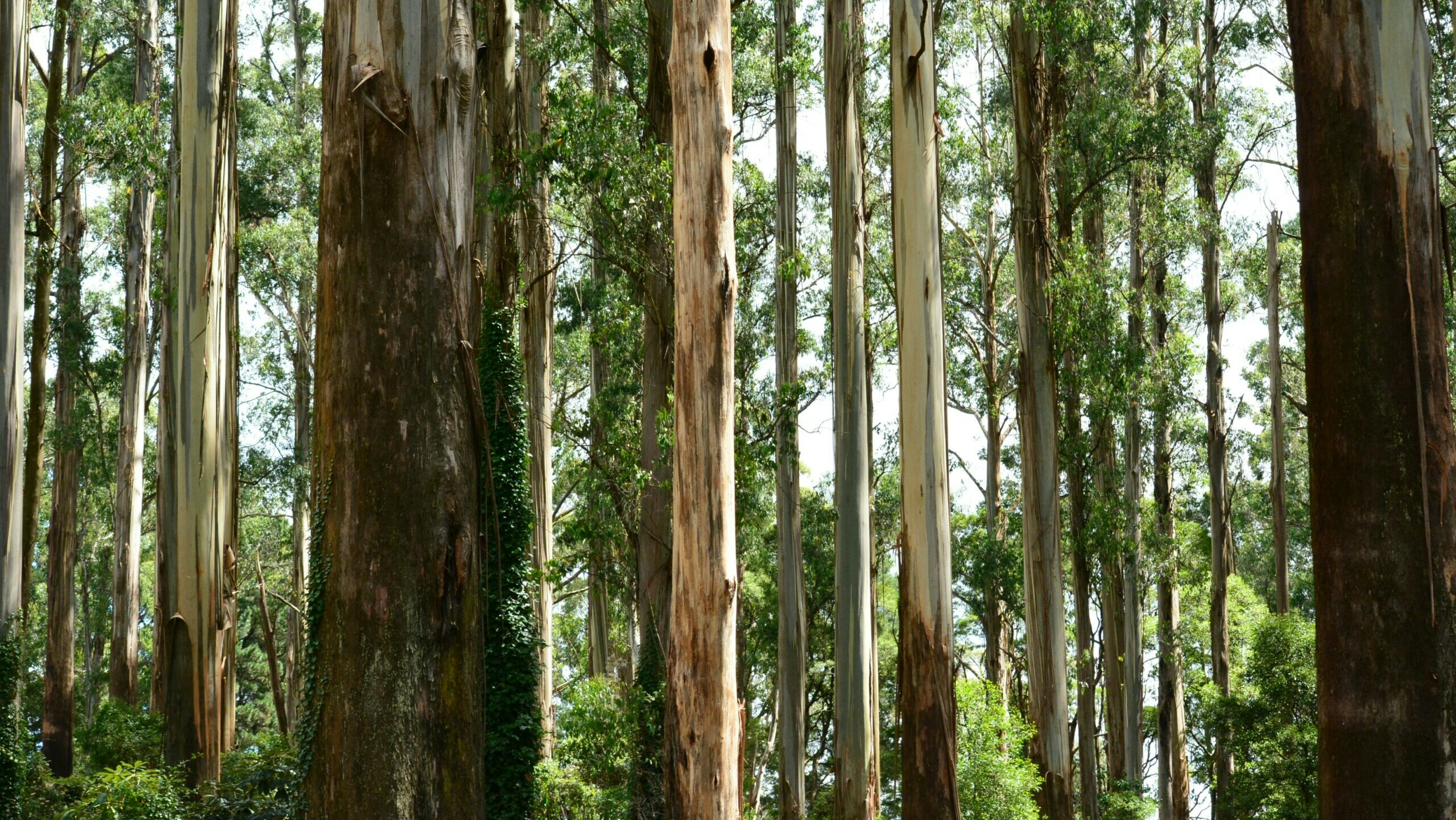
Australia’s Spirits Act of 1906 passed the world’s first legal product definitions for whisky†, brandy and rum by mandating pragmatic manufacturing parameters for a country with no native oak forests: ‘storage in the wood not less than two years.’ Australia has over 133 million hectares of hardwood forests and over 700 species of eucalyptus (the world’s tallest flower plant), which offers opportunities to utilise indigenous wood sources to develop a distinct Australian whisky flavour. The 1906 and 2006 Acts also set no limits on storage capacity, allowing brown spirits producers to mature spirits in small casks or large wooden vats, continuing an Australian tradition started by distilleries in the 19th century. Bundaberg has long stored rum in 9,100-litre oak vats from the 1890s, and today, 290 vats of 69,000 litres each. Ned’s whisky in Melbourne uses forty 14,000-litre oak vats.
By pioneering an Australian whisky style stored in native wood, it must aim to source sustainable timber at a competitively low price and, most importantly, deliver an acceptable and ideally differentiated organoleptic experience. The tasting criterion is imperative for an Australian whisky style to succeed in a highly competitive marketplace. In the past, many Australian wood species have proven too brittle, have insufficient pliability or porousness, are prone to shrinkage and splitting, or contain objectionable tastes or discolouring compared to European and American oak, the universally benchmarked cask wood. Some local species show promise, requiring longer seasoning and treatment to extract higher tannin levels and leaching of disagreeable or orthodox flavour compounds to ensure palatability against existing whisky-tasting norms.
Since European settlement, one of the first resources to be studied and exploited was native timber for buildings, shipping, furniture, packaging and containers. The Sydney Distillery, in 1827, was the first to experiment with local acacia and eucalypt storage vats; poor seasoning initially contaminated their spirit. Half a century later, in South Australia, an analysis of cask woods for liquor maturation assessed the economic and organoleptic value of native timbers in 1872. Casks coopered from native woods evaluated beer, wine, and distilled spirits storage compared with imported oak, notably the popular Quebec oak (6d per stave) and Memel oak (8d). Of fourteen local hardwoods tested, red gum was purported ‘best to oak,’ presumably for wine. However, it needed longer seasoning as it was accused of having an astringent taste and risked shrinkage. At 3d a stave, it was the most economical. Sawn blackwood needed four and a half times more steaming and treatments to reduce wood colour and extractive tannin; stringybark two and half times, but left a peculiar (unfamiliar) almond flavour, while jarrah at 4d a stave was full of pinholes and found the taste objectionable.
By the late 1870s, several dozen species were considered suitable for storing whisky, brandy and rum in the country’s five colonial jurisdictions. The two preferred genera for whisky were Eucalyptus and Acacia, notably mountain ash and alpine ash (Eucalyptus regnans & Eucalyptus delegatensis), along with blackwood (Acacia melanoxylon) and silver wattle (Acacia dealbata). Secondary wood sources were constrained by regional access and costs. Western Australia jarrah (Eucalyptus marginata), Kauri (Eucalyptus diversicolor) transported off the Great Dividing Range, coastal forests red gums (Eucalyptus rustrata & camaldulensis), she-oaks (Cauarin cumminghamiana), stringybark or messmate (Eucalyptus obliqua & various sub-species), Tasmanian myrtle (Nothofagus cunninghamii), and for some cask heads, especially rum, the inflexible Queensland yellowwood (Flindersia xanthoxyla).
 In the 1880s, Australia’s largest winery and brandy distillery, Seppeltsfield, also producing whisky, embraced blackwood for vats and casks. A significant motivation was the lower cost of local staves versus imported oak, ranging from 25% to 35% savings, with no reports of extraneous flavours adversely affecting public consumption. In the early 20th century, cost savings were usurped by supply problems when oak became either too expensive or unobtainable in Australia. Two years before the First World War in 1914, North American oak (Quercus alba) dominated imports, with 2.5 million staves per annum, followed by nearly one million Japanese oak (Quercus crispula & acuta) and only 7% shipments of Memel and European oak (Quercus robur & petraea). The war stopped European shipments and impeded American supply. By 1920, American oak remained scarce and expensive, and European oaks were unprocurable. Increasing tariff duties during the 1930s further stifled demand. Second World War caused more oak scarcities and high costs that continued to affect supply into the 1950s, forcing distilleries, breweries and wineries to fill the void with native casks. In 1950, over one million super-feet (300,000 metres) of native wood was coopered into casks.
Several years after Federation, the Federal Distillery in Port Melbourne employed mountain ash and blackwood casks to age their Boomerang whisky for at least three years, treating the new wood with caustic carbonate and acid to ‘season, sweeten or pickle’ the containers. Lloyd Brind, the owner of the Warrenheip Distillery outside Ballarat, praised Tasmanian myrtle as ‘equally good, trifle better’ than American and English (meaning European) oak for whisky maturation. Many Australian fortified wineries adopted local woods. However, eucalypts planted overseas had mixed responses in the ‘agricultural’ wine industry. California in the 1920s described discouraging results coopering their introduced eucalypt species, while Portugal’s blue gums (Eucalyptus globulus) reported in 1927 that 3,000 port casks made of blue gum shipped in ‘perfect satisfaction.’
Recent monadic releases by a handful of local distilleries have conducted tentative wood experiments, laying down whisky in red gum, stringybark, jarrah, and macadamia casks, testing ironbark staves, and using other wood inserts to assess the flavour contributions. While historical records make no mention of public or trade reactions to whisky matured in native woods, it indicates the potential for a new flavour frontier for Australian country whisky awaits discovery.
* New oak containers contribute about 80% to the flavour of whisky (i.e., bourbon). Second-use, up to 60% (i.e., Scotch/Irish). Lighter, more delicate styles of whisky are significantly less, under 50%, as inert wood acts primarily as the membrane for oxidisation. Variability is also subject to container capacity, treatment (roast, char, STR), storage environment, number of repeated refills, duration of usage, etc.
† Tax reduction laws began permitting the deferral of excise duty, allowing more extended bond storage before sale to prevent fraud, and making allowances for leakage and evaporation, served as tax and excise concessions: 1834 U.K. wastage allowance, 1868 U.S., and 1887 Canada for a 12-month bond deferral before tax. Legislation on whisky’s manufacturing standards and definitions on what constituted whisky was enacted in Canada in 1911, the U.S. in 1935, the U.K. in 1933, and Ireland in 1950.
This instalment concludes Chris Middleton’s Mighty Oaken Cask series, which began in December Outturn 2023. You can read the past issues throughout Outturn or on our site’s blog Whiskywise.
This article is featured in the May 2025 issue of Outturn Magazine — bottles will be available to purchase on Friday the 2nd of May at midday AEST exclusively to members of The Scotch Malt Whisky Society. Not a member? Click here to learn more about the world’s most colourful whisky club.